Seawall, Revetment or Bulkhead? Matching the Structure to Your Shoreline
The biggest mistake in coastal protection is buying the structure instead of buying the performance. A revetment, a seawall and a bulkhead do three different jobs, and the one that fits your Charleston shoreline depends on wave energy, bank height, substrate and how the land behind is used.
Three structures, three jobs
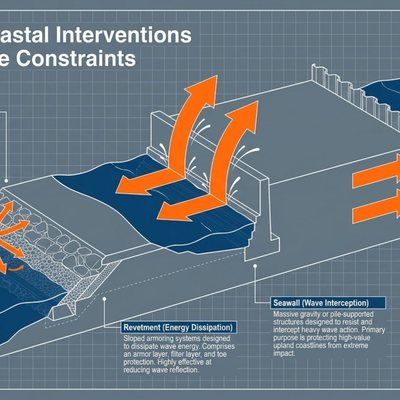
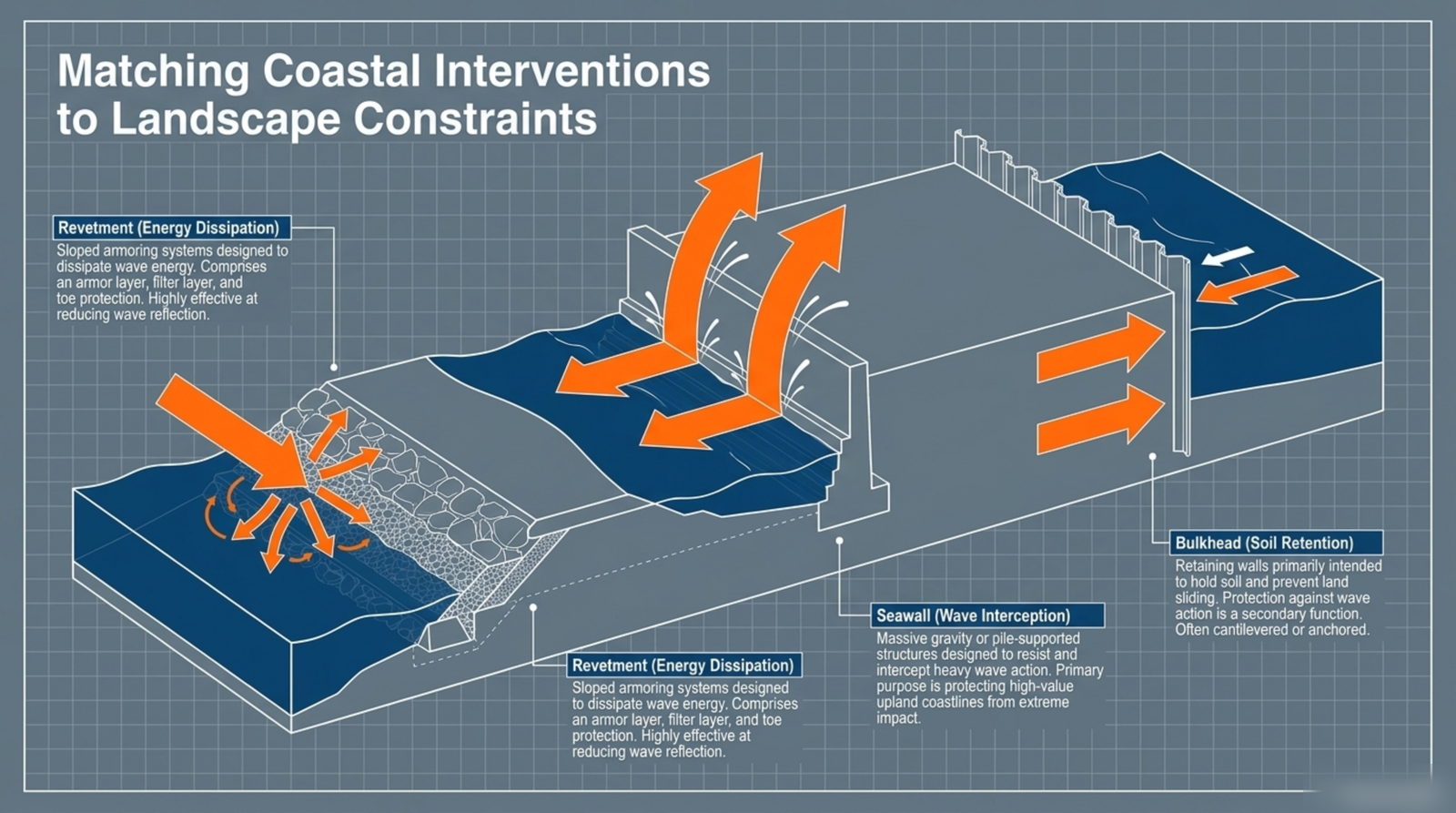
“Seawall” gets used for all three families, but they behave differently. A revetment is a sloped armour layer laid on the bank — it dissipates wave energy across its face. A seawall is a vertical or near-vertical structure that intercepts waves and holds the upland back. A bulkhead is a retaining wall whose main job is to hold fill in place — typically sheet piling or timber, and typically the lightest of the three in wave exposure.
The practical rule from the design guidance: match the structure to the wave energy it will actually see. A sloped revetment handles energy it can dissipate; a vertical wall has to absorb it. Where wave energy is high and the alignment cannot be sloped, the wall has to be much heavier, deeper and better protected at the toe.
How long each material actually lasts
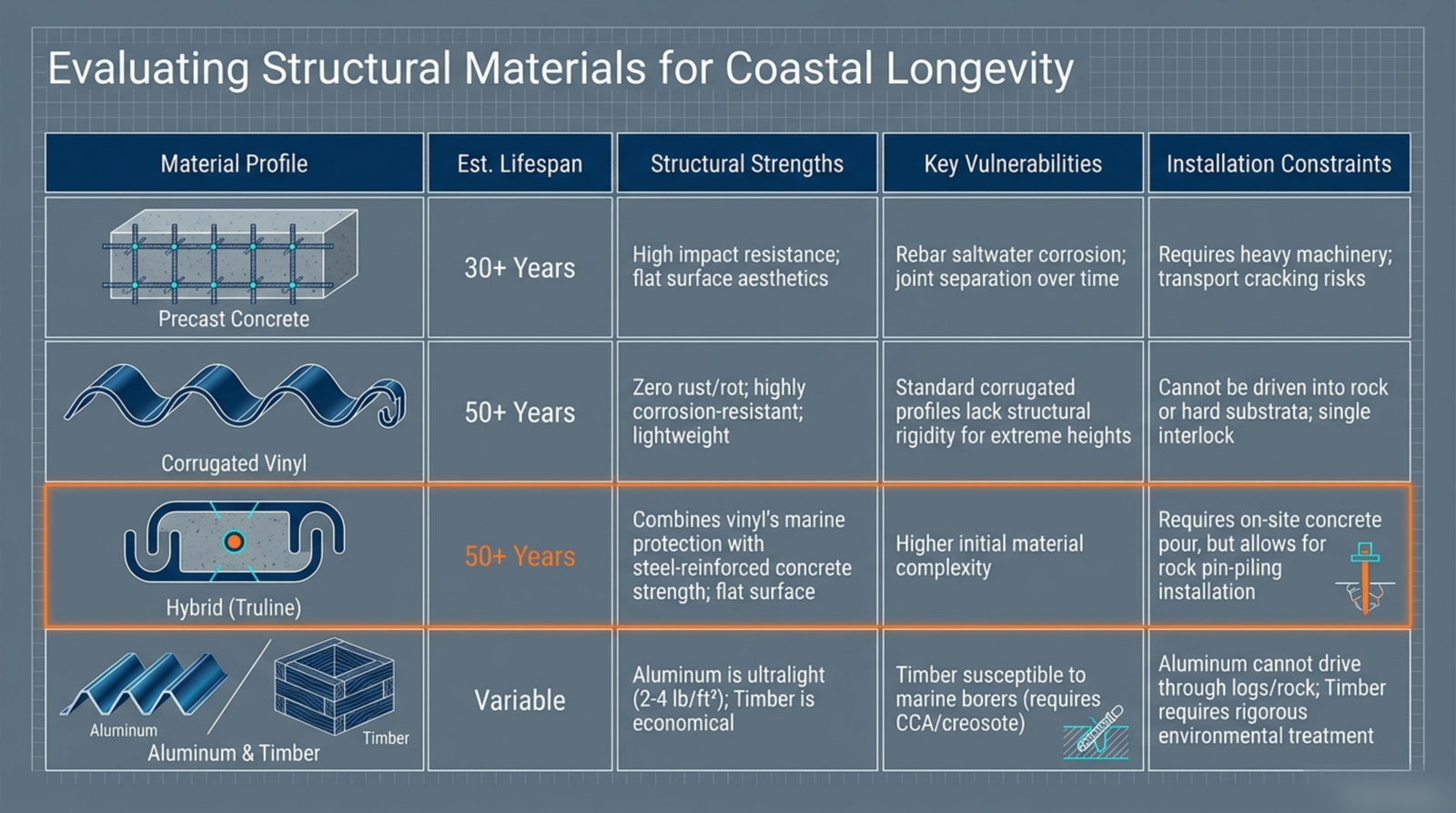
Design life is where cheap options quietly stop being cheap. In the cost model we maintain for coastal protection work, the ranges below are typical service lives before major rehabilitation — not a warranty, and not a substitute for a site-specific design:
- Precast concrete panels: 30+ years, but the cap is the vulnerable part — salt reaches the reinforcement and rust staining is the early warning.
- Corrugated vinyl sheet piling: 50+ years, immune to rot and borers; the trade-off is installability — it needs the right substrate to drive through and stiffeners where it spans soft ground.
- Hybrid (vinyl-clad) sheet piling: 50+ years, combining a structural core with a corrosion-resistant casing.
- Treated timber: economical and easy to repair, but it depends entirely on the preservative and on borer pressure — the treated-wood guidance for aquatic use covers exactly this (CCA/ACZA/ACQ systems, creosote, and the marine-borer risk that varies by region and salinity).
- Aluminium: light and fast to install (a few pounds per square foot), but it pits in organic muck and near dissimilar metals.
Sizing armour: the calculation that decides the stone
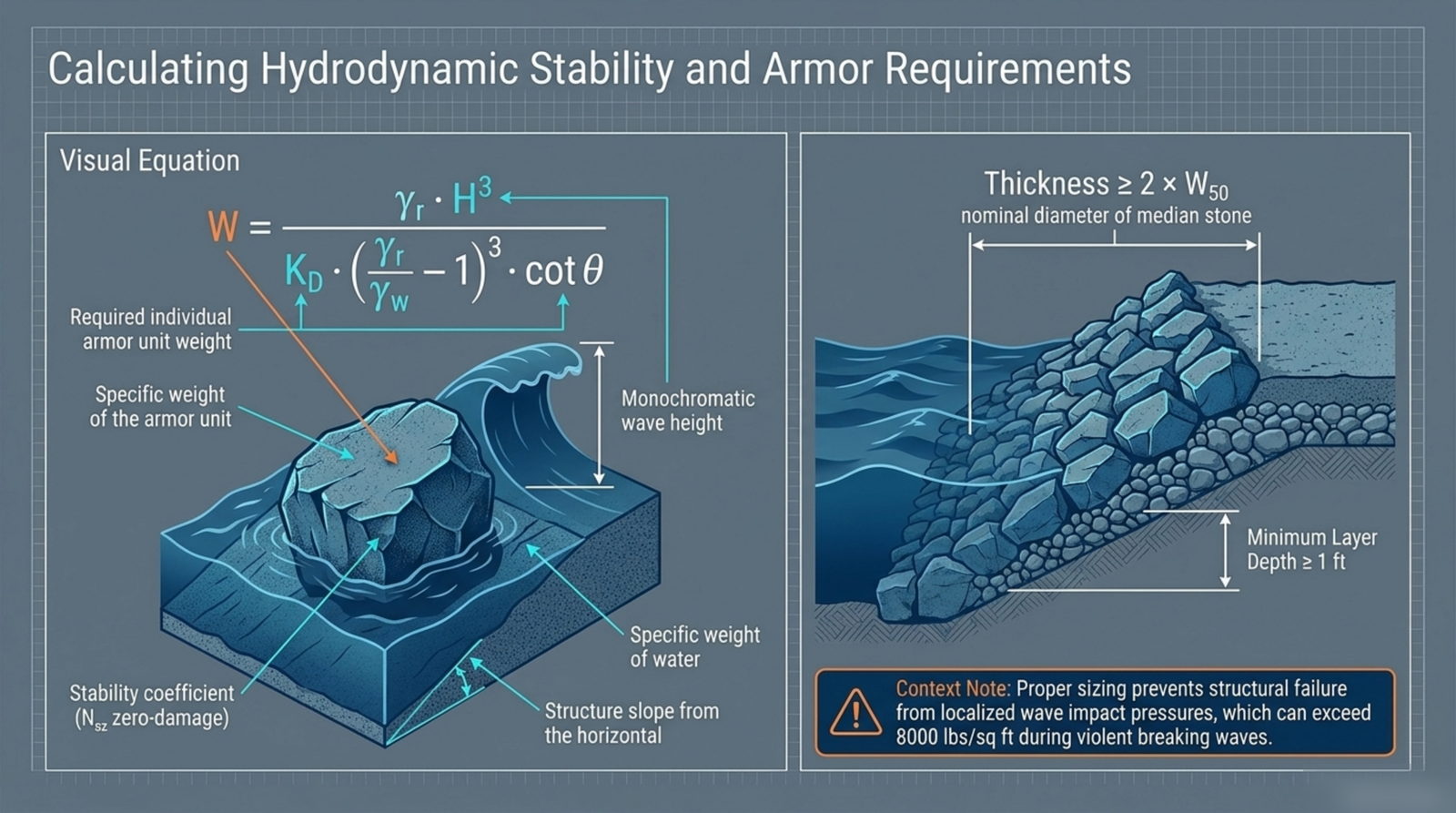
For revetments and riprap, the design question is stone weight. The standard is the Hudson equation, and USACE publishes the recommended stability coefficients (KD) for each armour type — 2.0 for rough angular quarrystone, 7.0 for tetrapods, 9.0 for tripod units, 15.0 for dolos, all under breaking-wave conditions (EM 1110-2-1614, Table 2-3). Weight scales with the cube of wave height, which is why a wall sized for a 2 ft wave is nowhere near adequate for a 5 ft one, and why the manual warns that graded riprap should not be used above about a 5 ft design wave.
Our armour sizing calculator runs that equation for you and shows the median stone weight, the equivalent cube dimension and the stability number, so you can see what a quote is (or isn't) designing for.
Crest elevation: the number homeowners never ask about
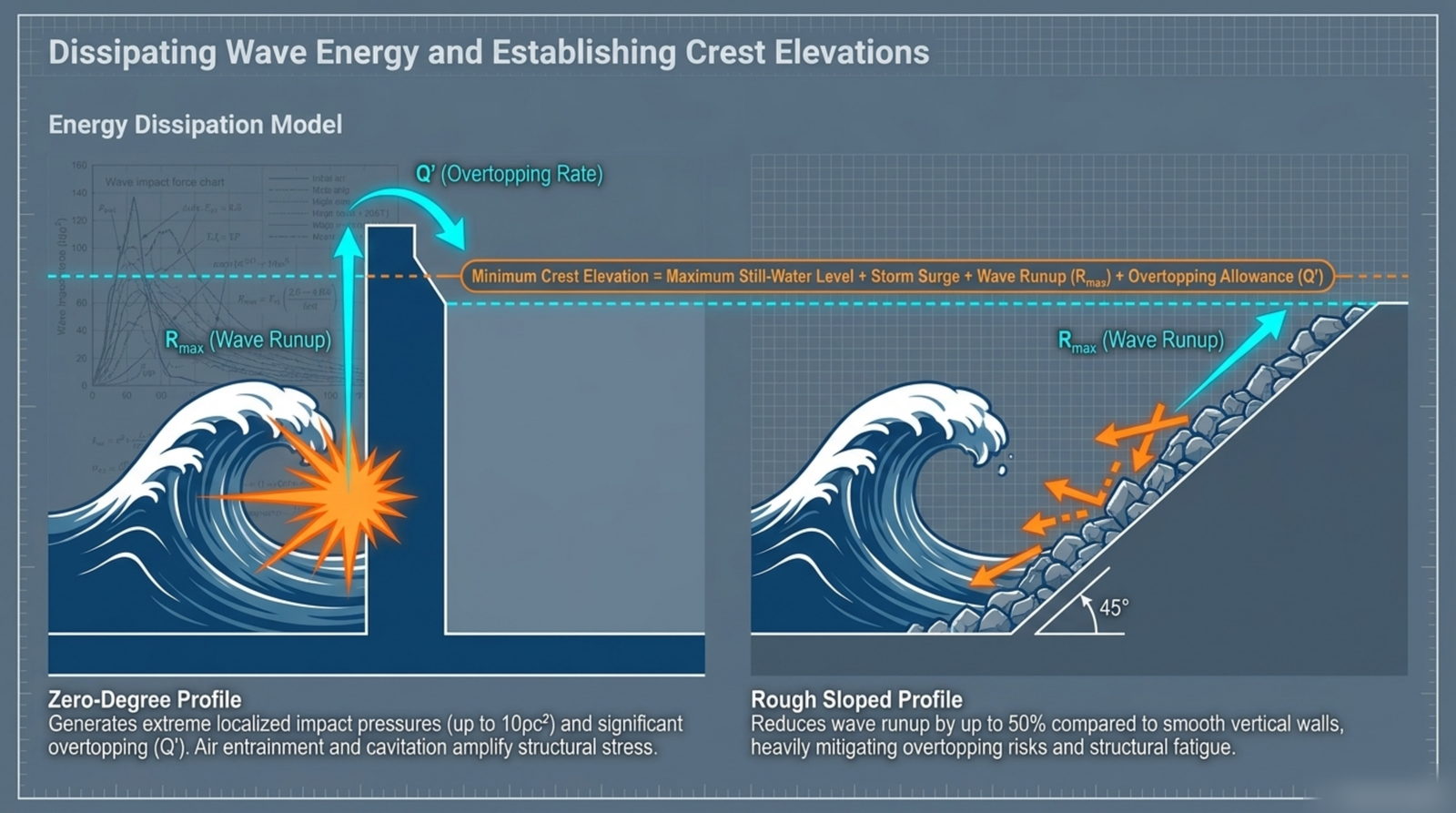
A wall can be structurally sound and still fail functionally — by letting water over the top and eroding the fill behind it. The minimum crest elevation is a stack of terms: still-water level, plus storm surge, plus wave run-up, plus an allowance for overtopping (EM 1110-2-1614, §2-4 Height of Protection; run-up correction factors in Table 2-2).
Two consequences matter when you compare quotes. First, a rough sloped face reduces run-up compared with a smooth vertical face, so it can allow a lower — and cheaper — crest for the same protection. Second, if the design wave is underestimated, the wall doesn't just get wet: overtopping flow scours the landward side.
The foundation: filter, apron, flanks
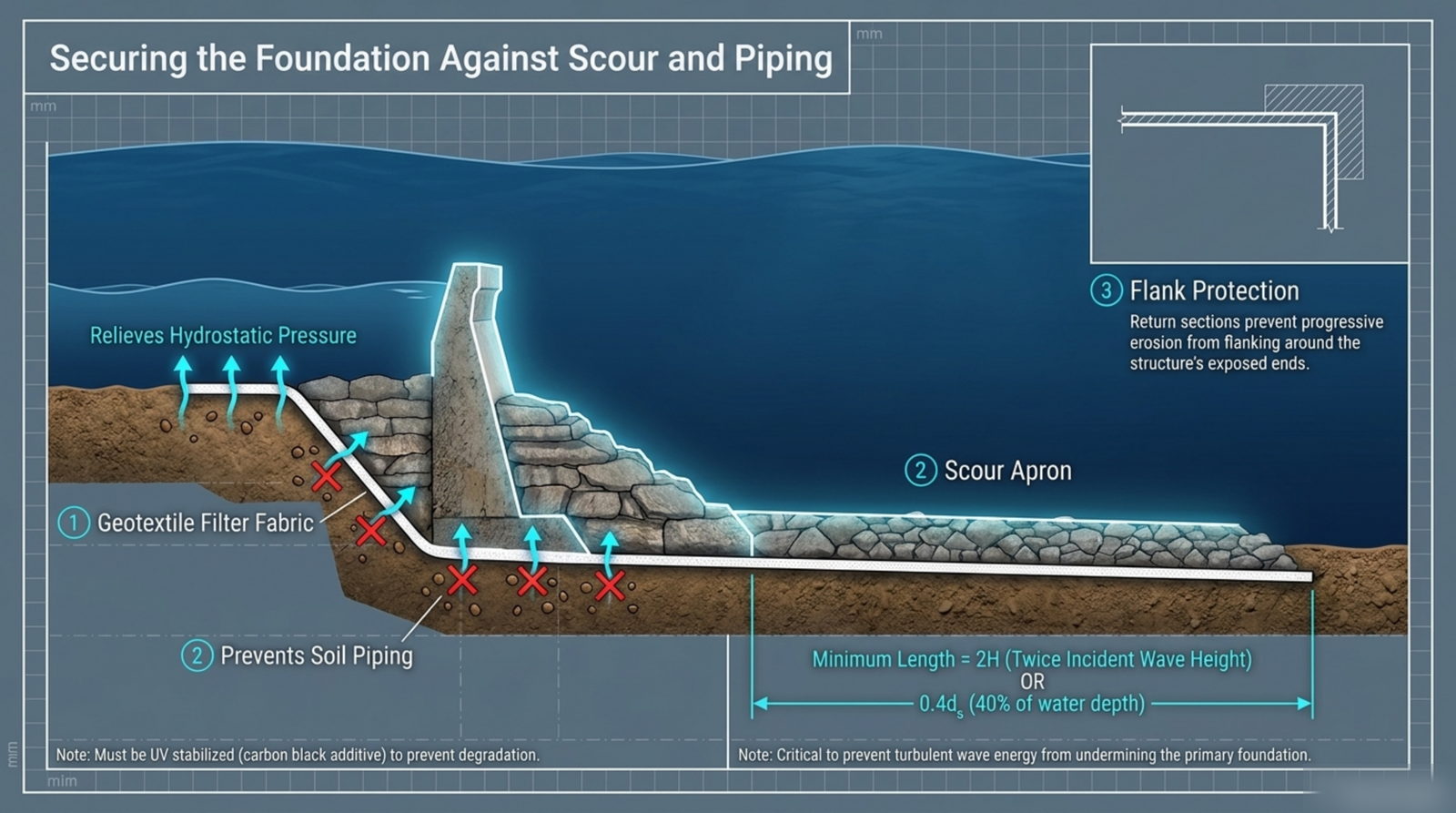
Three details decide whether a well-built wall survives 30 years:
- Filter fabric / geotextile. Open joints and weep holes must not become escape routes for your backfill. Fabric keeps the soil in while letting water out, which also relieves the hydrostatic pressure that would otherwise push the wall outward.
- Toe apron. USACE calls for toe protection at least twice the incident wave height for sheet-pile walls; New York's erosion guidance likewise treats toe protection as the defence against undermining.
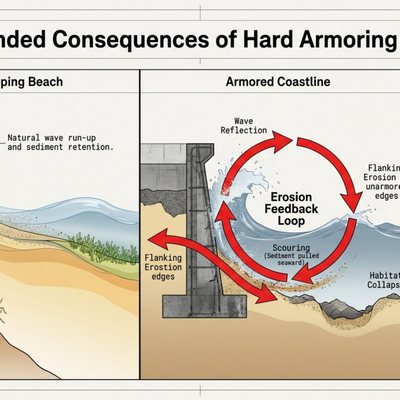
- Flank (return) protection. USACE's manual warns specifically about erosion continuing around the ends of a wall — the flanking effect — which is why return sections that tie into stable ground matter as much as the wall in the middle.
Sources
- USACE EM 1110-2-1614, Design of Coastal Revetments, Seawalls, and Bulkheads (30 June 1995)
- Treated Wood in Aquatic Environments (preserved wood industry guidance)
- NY DEC — Protection Against Wave-based Erosion (revetment design guidance)
Every figure quoted above is traceable to the sources listed; where a claim could not be verified it was left out. Links accessed 12 September 2026.
Need a Charleston pro to look at your wall? Call (843) 892-8561 for a free, no-obligation quote from a pre-vetted local seawall contractor.